























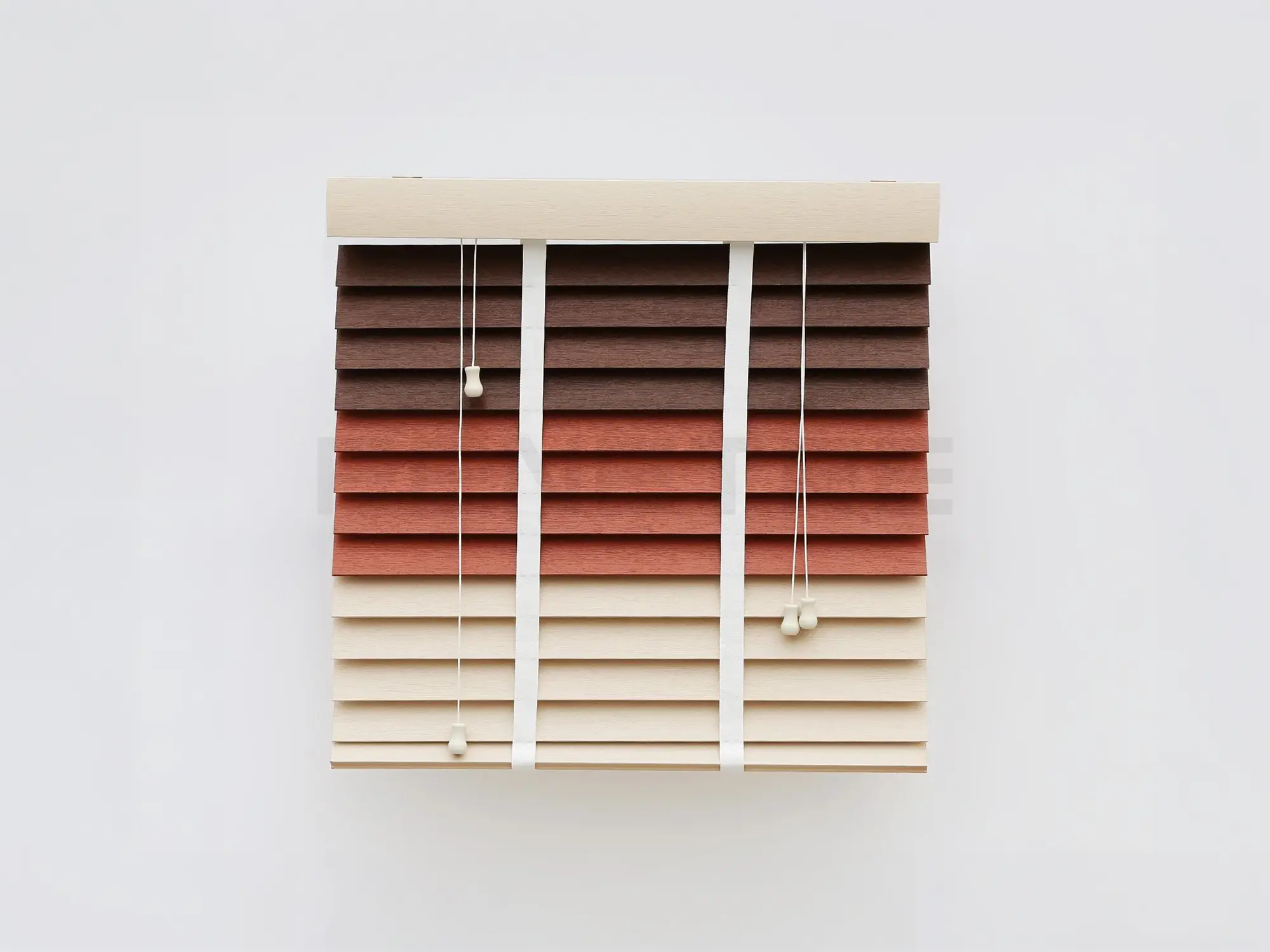
63 mm Wooden Venetian Blind
63 mm wooden venetian blind. The widest of the wooden louvre sizes — a few wide louvres give maximum openness and a prestigious look on wide windows.
- Natural WoodThe widest-louvred wooden series.
- Maximum OpennessThe widest louvre — an uninterrupted view.
- PrestigeThe strongest presence on wide windows.
Who Is the 63 mm Wooden Venetian Blind For?
- Wide Window
- Lounge
- Villa
- Executive Office
- Hotel Lobby
The widest wooden louvre — maximum openness on large glazed surfaces; the wood grain reads strongest at this size.
63 mm Wooden Venetian Blind
- Stock Code:
- FS-JLA-03
- Availability:
- Produced to Order
- Brand:
- FENETRE
- Category:
- Wooden Venetian Blinds
Wide louvres and reinforced brackets are produced to measure — it arrives with the weight balance and bracket count calculated.
On large glazed surfaces the louvre density drops — in the open position the panorama stays almost uninterrupted, and closed, the wood texture comes forward.
This is the series with the lowest louvre count per square metre — because each louvre covers a wider surface, the grain and the wood character read strongest at this size. On narrow glazing the proportion breaks; the model is primarily for wide openings.
On large lounge and lobby facades the few-parts, wide-surface effect strengthens the architectural emphasis — the window stops being an ordinary opening and becomes the room’s defining element.
Technical Specifications
63 mm Wooden Venetian Blind technical production data
- LouvreA solid-looking wooden surface
- Natural Wood
- Louvre WidthThe widest wooden louvre width
- 63 mm
- MechanismA mechanism balanced to heavy louvres
- Wand / Chain
- MountingA heavy headrail wanting dowel mounting
- Inside / Outside Recess
- ControlAn uninterrupted panorama opening
- Lift + Tilt
- CompatibilityWide glazed surfaces
- Office · Home
The wide, heavy louvre build wants dowel mounting — the brackets hold to a solid surface.
The tilt mechanism is balanced to the wide louvre’s weight.
The carrier-bracket count is taken by the opening width — on split orders two blinds are fitted side by side aligned to the mullion line.
- The wide glazing’s total width and height are taken (cm).
- The bearing surface’s material is written — concrete or a solid wall is recommended.
- Account for the stack height of the louvre package.
- At widths requiring split production, the mullion position and the carrying route are noted.
A 63 mm louvre occupies a marked height when gathered — the space above the window is measured; on plaster and hollow-block surfaces a bearing allowance is added.
The wide louvre’s visual and technical balance
In rooms with wide glazing — a villa lounge, a hotel lobby, an executive office — a slim louvre builds a crowded texture; at 63 mm the louvre count drops and the surface looks calm, like a panelled facade, even with the blind closed.
A wide louvre is heavier in a single piece — the mechanism is therefore balanced to the weight and the brackets tie to a solid surface with dowels; the pull force during lifting is lowered by a geared mechanism.
In the open position the gaps reach their widest — on facades facing a sea, garden or city view, an uninterrupted view is provided without needing to gather the blind.
Colour, coating and project match
The louvres are chosen in natural wood tones according to the room’s veneer palette — the range running from light oak to dark walnut reads in a similar tone to the parquet and door joinery; when a sample section is requested, a real louvre piece is sent and the colour decision is made on the material, not a catalogue image.
The ladder tape and tilt wand match the louvre colour — closed, the system reads as a single whole surface; in projects wanting contrast, the tape colour is taken separately.
In architectural projects the louvre width is drawn into the technical drawing as 63 mm — bracket spacing, headrail depth and stacked-height values come from the production data; after the site survey the measurement is confirmed and production is built to that final figure.
The right window, the right size
The model’s yield is directly proportional to the glass width — on narrow and medium windows the louvre looks disproportionately large, so the clear-opening figure is asked before production and a 50 mm option is recommended where needed.
The stack height is the second measurement to account for — wide louvres form a taller package at the top; on recess mounting the space above the window is written in the measurement.
Cutting, lacquering and balance setting are finished on the Gebze production line — the mechanism is calibrated to the weight and shipped fitted; dowels and the mounting diagram are in the package.
One panel or a split on a very wide facade
Once the glass width passes two metres, a single blind’s weight strains the practical limit — the load on the lift cord and the mechanism grows; at that point the facade is split into two independent blinds, each working with its own control.
In the split decision the glazing mullion axis is taken as the base — if the line where the two blinds meet is aligned to the joinery mullion, the gap visually disappears; at medium sizes wanting a single-panel look, a single blind is produced.
In a split layout the two sides are used independently — the sun-facing wing closes while the other stays open; on a wide facade this flexibility gives control a single-panel blind cannot.
Order and installation planning
A wide, heavy panel wants a two-person crew on site — for applications within Istanbul and Kocaeli the installation service is specifically recommended; that the bearing surface is concrete or solid is verified during measuring.
On flat-pack shipment the package length grows with the louvre width — the staircase and lift dimensions are checked first; in tight-entrance spaces split production makes carrying easier.
Clear opening, wall material and the space above the window are the three core details — once sent, price and the production schedule are provided the same day.
On the heavy series, delivery planning matters as much as production — the package route, carrying to the floor and the installation day are settled in advance; this layout gives a surprise-free install on wide-opening projects.
An architectural accent on prestige facades
In high-representation rooms like villa lounges, hotel lobbies and executive offices, the 63 mm louvre adds mass to the facade — a few wide pieces make the wood texture readable even from a distance.
In high-ceilinged volumes a slim louvre disappears — the wide size stays proportional to the window; as ceiling height grows the louvre width should grow too, and 63 mm is the upper limit of that proportion.
The motorised layout is especially valuable in this series — lifting heavy louvres is done by remote instead of a cord, tilt adjustment stays precise, and the access problem at high mounting points disappears.
Questions About 63 mm Wooden Venetian Blind
Can a 63 mm louvre go on a narrow window?
Are wide louvres easy to clean?
Does the heavy headrail cause problems on a wall?
Does a 63 mm louvre work with a motor?
If split into two blinds, does a gap remain?
How tall does the stack get?
One piece or split on a big window?
Can it mount on a plaster wall?
Who undertakes the venetian installation?
Into how many sections can it split?
Does it arrive in a long package?
Other Wooden Venetian Blinds Models
63 mm Wooden Venetian Blind is built around natural wood, maximum openness, prestige. The remaining 2 models in the Wooden Venetian Blinds range are listed.
63 mm Wooden Venetian Blind — Send Your Measurements
Send the wide-glazing measurements, the bearing surface and the split-production need to receive the 63 mm wooden price.