
























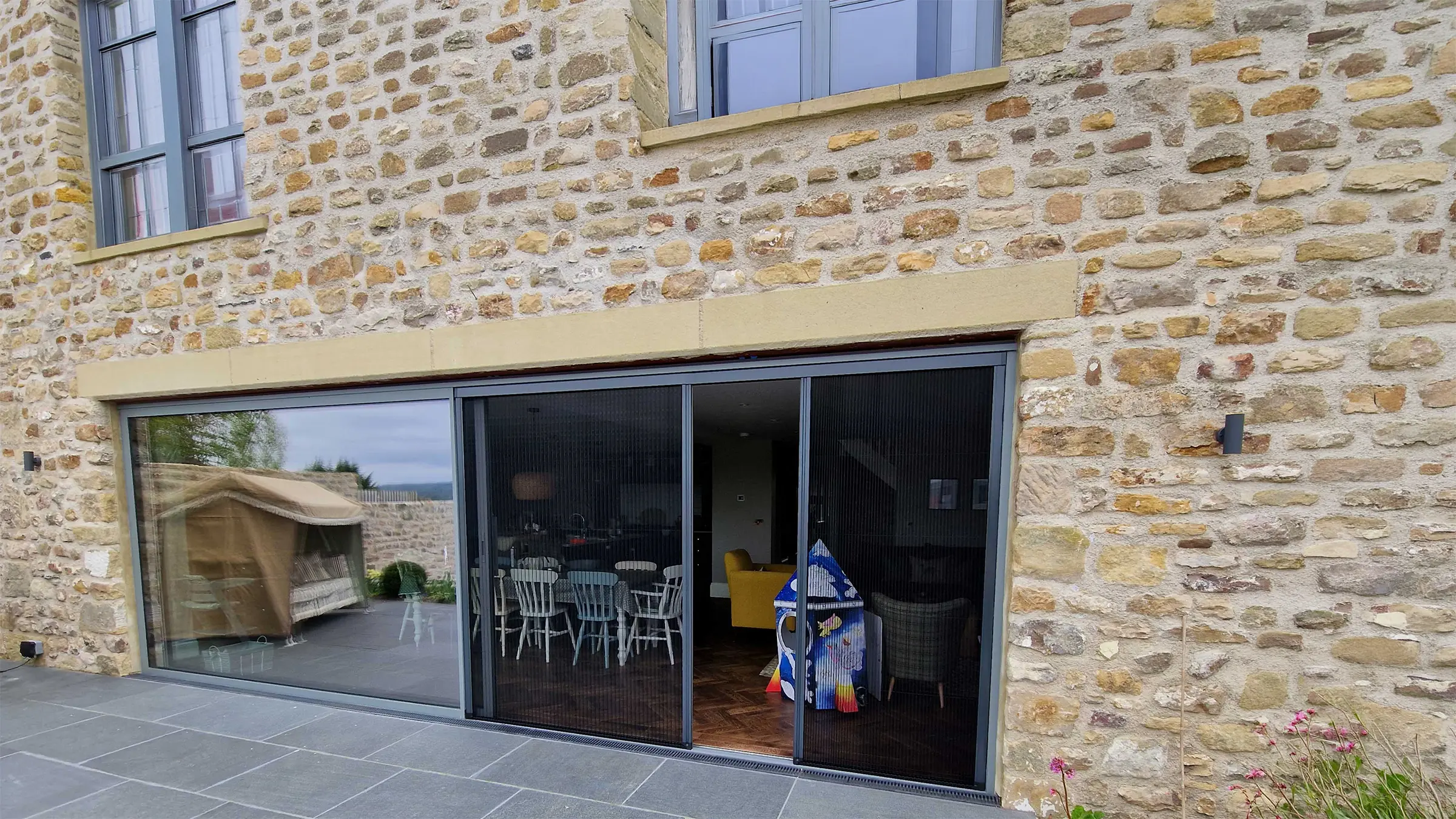
Pleated Insect Screens
Accordion-folded mesh. No springs, no roll-up. It stays wherever you leave it.
Pleated Insect Screen Models
Five frame sizes. The profile is chosen by the depth of the joinery inner gap.
15 mm Pleated Insect Screen
The slimmest frame. It fits the narrowest gap beside a shutter rail.
18 mm Pleated Insect Screen
The window standard. A series designed around the shutter-rail gap.
25 mm Pleated Insect Screen
Wide-frame profile. For doors and frequently used openings.
26 mm Pleated Insect Screen
Bottom-channelled door series. The mesh stays in the rail in wind.
27 mm Pleated Insect Screen
The deepest frame. For double-leaf layouts and the widest openings.
The technical details of inner-mount, outer-mount, sliding, double, vertical and threshold-free connection layouts are listed by connection type on the Pleated Insect Screen Installation Types page.
What Is a Pleated Insect Screen?
A pleated insect screen is a system in which accordion-folding mesh is held in place by tension cords. There is no spring or roll-up mechanism — the mesh stays where you leave it, runs silently and, with a double leaf, closes metres-wide openings.
Two things decide the choice: passage direction and the threshold. For doors, the horizontally folding sliding model; for windows, the vertically folding vertical model is the right pick. The profile table below settles the threshold choice.
Selection Guide
Which Joinery Gap?
Choose not by product name but by the inner-gap depth of the joinery. The four scenarios below point to the right series.
Choosing the Frame Size
The five frame profiles are ranked by joinery inner-gap depth and usage surface. The model name in each row links to its own product page.
| Model | Frame | Inner Gap | Window | Door | Note |
|---|---|---|---|---|---|
| 15 mm Pleated | 15 mm | Narrowest | Full | Partial | The slimmest profile. For joinery with a narrow gap |
| 18 mm Pleated | 18 mm | Narrow | Full | Partial | The balance point for standard inner gaps |
| 25 mm Pleated | 25 mm | Wide | Partial | Full | Solid over doors and frequently used openings |
| 26 mm Pleated | 26 mm | Deep | Partial | Full | Bottom-channelled; the mesh stays in the rail in wind |
| 27 mm Pleated | 27 mm | Deepest | Partial | Full | Double-leaf layouts and the widest openings |
- Full. Meets the scenario completely
- Partial. Contributes depending on the case
- — not suited for this purpose
Inner gap. The joinery depth the frame seats into — confirmed by measurement. Window–Door: the usage surface the series is recommended for.
Choosing the Threshold Profile
The most critical decision of a pleated screen is the threshold. Three profiles define the passage comfort.
- ~20 mm
Single Ramp
The standard pleated threshold. A one-sided ramp that integrates with a hard floor.
- Passage Comfort
- Accessibility
- Economy
- Height
- ~ 20 mm
- Passage
- Comfortable for adults
- Use
- Windows and rarely used doors
- ~10 mm
Double Ramp
A two-way ramp. It softens the threshold from both inside and outside.
- Passage Comfort
- Accessibility
- Economy
- Height
- ~ 10 mm
- Passage
- Step over with light pressure
- Use
- Balcony and terrace doors
- ≤7 mm
Threshold-Free
A bridgeless profile. The floor is nearly flat. The trip risk is practically gone.
- Passage Comfort
- Accessibility
- Economy
- Height
- Under 7 mm
- Passage
- Barrier-free. Step-free for wheeled passage and carrying loads
- Use
- Frequently used doors, accessibility
Threshold heights are industry reference values. The exact figure is stated in the quote per the chosen profile series.
From Measurement to Delivery
In a pleated system, the threshold and profile selection is settled in the quote. Delivery in four steps.
- 01
Opening Measurement
The width-height measurement and a photo of the door are enough. Requests from every channel merge into a single order file.
- 02
Threshold and Model Settled
Sliding, threshold-free or double. The profile is chosen in the quote according to the passage need.
- 03
Accordion Folding
The mesh is folded in Gebze and the tension cords are set. The lead time is written into the order.
- 04
Fitting or Courier
Within the service area, the install crew fits on site. For out-of-town addresses, a knock-down shipment goes out.
The details of threshold and profile mounting styles are explained per model on the Pleated Insect Screen Installation Types page.
- Accordion FoldNo springs, no roll-up. The mesh gathers in pleats and rests silently.
- Slim FrameThe 15 mm frame hides behind a shutter rail. No profile visible on the façade.
- Vectran Tension CordThe tension cord that keeps the mesh in its pleats. It neither stretches nor snaps for years.
Questions About Pleated Insect Screens
Is a threshold-free pleated screen truly flat?
How wide can a pleated insect screen be made?
Will my cat damage the mesh?
Should it open vertically or horizontally?
What is the difference between a pleated and a roller insect screen?
How do I clean a dirty mesh?
How do I send my measurements?
Which Pleated Insect Screen?
Question 1/3How wide is the opening?
Is a threshold-free passage a must?
Is the priority looks or comfort?
Recommended solutions
The two best matches for “Which Pleated Insect Screen?” based on your answers — the scores stay with you, the reasoning is ours:
Both options matched strongly for Which Pleated Insect Screen? — pick the one that fits your priority; if undecided, we clarify it at the survey.
Single Leaf + Threshold-Free Rail
Bottom rail under 7 mm — trip-free passage, ideal for narrow openings.
Double-Leaf Pleated
A symmetrical system closing from both sides across wide openings.
Slim-Frame Pleated
15 mm-class profile — for joinery where a minimal look is wanted.
To apply your “Which Pleated Insect Screen?” result without measurements, see the measuring and installation guide; installation is free in Istanbul and Kocaeli, and in other provinces the installer partner network takes over.
Send Your Opening Measurements
For a pleated system, the width-height measurement and a door photo are enough. The quote is shared within 48 hours.