























Motorised Blind
Motorised blind. The version of the roller blind driven by a tube motor and managed by remote control and automation.
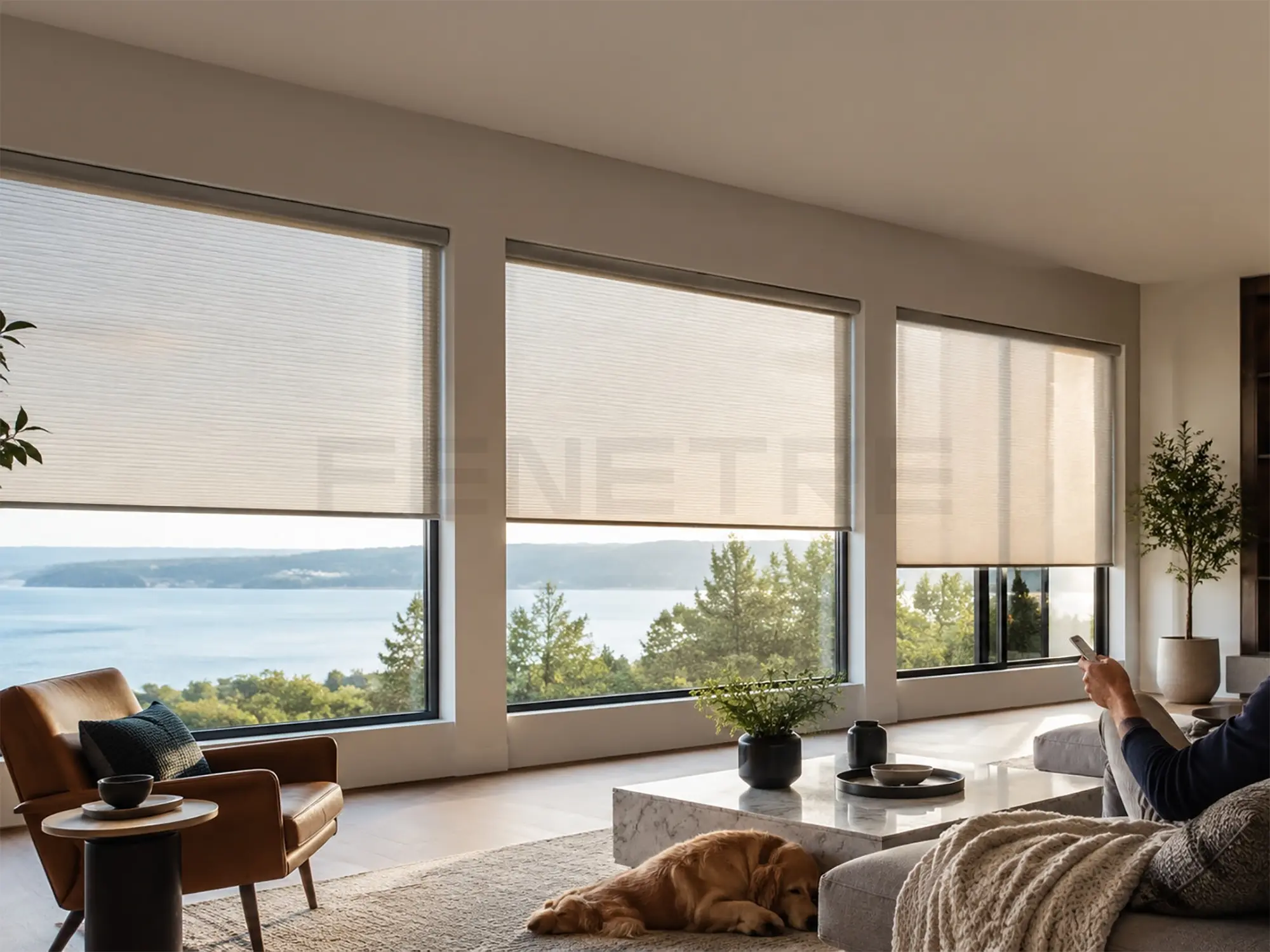
- Remote ControlOpen, close and stop at a touch.
- Motor ReadyConnects to smart-home infrastructure.
- Wide BlindsBalanced running on heavy fabric.
Who Is the Motorised Blind For?
- High Glazing
- Hard-to-Reach Windows
- Smart Home
- Cinema Room
- Elderly Use
Managed by remote or automation — adapts to roller and zebra systems.
Motorised Blind
- Stock Code:
- FS-PRD-06
- Availability:
- Produced to Order
- Brand:
- FENETRE
- Category:
- Curtains
Motor and tube are joined to measure — it arrives with remote pairing done.
On wide and heavy blinds it removes the chain pull — it connects to the smart home.
Technical Specifications
Motorised Blind technical production data
- FabricScreen · Blackout · Zebra
- Roller — All Types
- Tube
- Aluminium
- MotorBattery / wired
- Quiet Tubular
- Mounting
- Wall / Ceiling / Recess
- Control
- Remote · Motor
- Compatibility
- Home · Office
The motorised tube seats on the brackets — remote pairing and limit setting are explained in the guide.
Battery-powered or wired motor options are available.
- The window surface’s width-height is measured (cm).
- The battery or wired preference is written.
- The remote and motor connection plan is noted.
A battery motor needs no power line — a wired motor works without interruption.
Motor options and the supply
The motorised blind is produced with three supplies — a wired line, a rechargeable battery and a solar-panel-backed charge. The cable line is laid during renovation; on an existing building the rechargeable motor needs no cable and charges every six months.
The remote gives single-unit or group control — units in the same room run on separate channels from one remote or lower together in a single move; a timer function builds the morning-open, evening-close routine.
The smart-home connection splits by motor type — an RF remote motor connects to a phone app through a bridge; a wired BUS system goes straight into the motor panel. This distinction is settled on the order.
When a motor is needed
Hard-to-reach windows are the motor’s main reason — on a gallery void, a high ceiling or a stairwell window there is no chain or cord access; a position change by remote is that window’s only practical solution.
On a multi-unit facade the daily routine drops to a single move — adjusting a ten-unit lounge facade by hand takes minutes; a group remote brings the whole facade to the same position in seconds.
Motor noise influences the product decision — the quiet series is chosen for bedrooms and hotels, a standard motor is enough for an office; the noise level is written in decibels in the table.
System setup and the channel programme
The remote channel decides the unit grouping — each unit is assigned its own channel or a whole facade works together on one channel; the channel programme is set on installation day and changed afterwards.
The supply plan is made by the unit’s position — on a wired line every unit receives a feed; on a rechargeable motor the charge port is kept accessible and a charge cycle is set.
Synchronisation is done on multi-unit facades — on a group command the units lower at the same speed; a speed difference breaks the facade layout. The sync setting is a delivery step.
A motor bridge opens phone control — the RF remote motor connects to the Wi-Fi network through the bridge and the timer programme runs; the bridge is kept at the centre of the home.
Sun and wind sensors give the motor passive behaviour — when a condition passes the sensor threshold the unit moves on its own; the facade is run through the day without manual touch.
The motorised blind works with a tube motor — the motor inside the tube winds and collects the fabric, operated by remote or a wall switch.
Application and space selection
In a smart-home project the blind becomes part of the automation — alongside the lighting and climate programmes the blind is timed too, automating daylight and heat management.
In a hotel it connects to the room control panel — the guest manages the blind from the bed while the central system monitors all rooms.
Control-type list
On high, wide or multi-unit use a motor is chosen — wherever pulling a chain is hard, the motor’s comfort decides.
In a project planning a smart home the protocol match is verified — a motor compatible with the existing infrastructure is chosen; a mismatched protocol blocks the connection.
The battery-or-cable choice follows the wiring — a wired motor near a socket, a battery motor where no line exists; charge access is arranged.
Fabric weight decides the motor strength — on blackout and dual-layer fabrics a high-torque motor is used; the fabric choice is made with the motor.
If the motor fails the fabric can be lifted by hand — use does not stop; the backup plan provides security.
Questions About Motorised Blind
Does a motorised blind work during a power cut?
Which fabrics can it be used with?
Other Curtains Models
Motorised Blind is built around remote control, motor ready, wide blinds. The remaining 7 models in the Curtains range are listed.
Motorised Blind — Ask for a Price
Send the glazing width-height and the control preference to receive the motorised-blind price.